
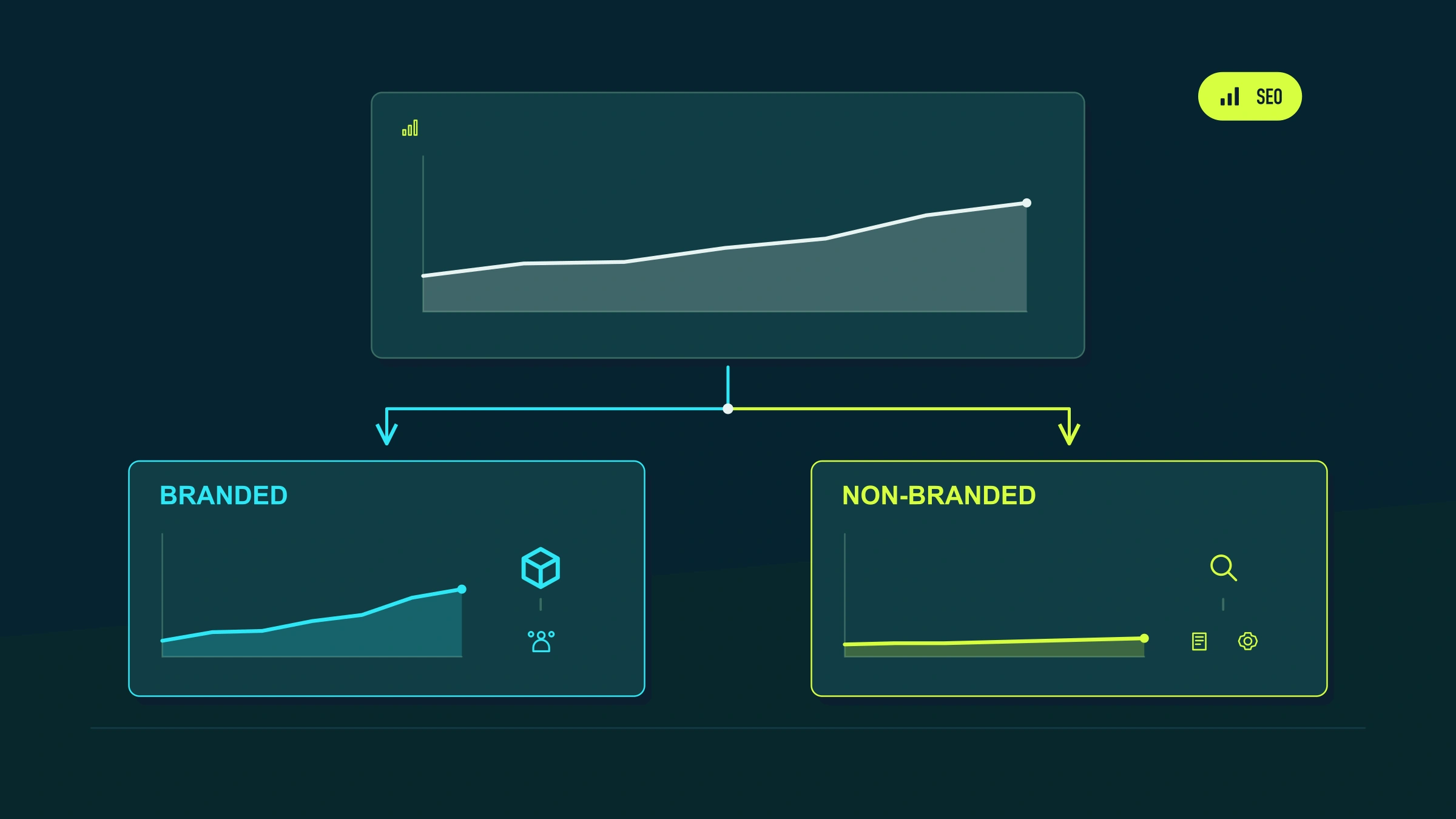
Imagine opening Search Console and seeing good news: organic clicks rose from 7,000 to 10,000 in just a few months.
That is a 43% increase.
The temptation is obvious: say that SEO is growing.
But one question is missing.
What were people searching for before they clicked?
If much of that growth comes from people typing the company name directly, its product, or some variation of the brand, the data is still positive. The brand is generating interest.
What it does not necessarily mean is that SEO is capturing much more new demand.
Since 2026, Search Console has made this distinction much easier thanks to its query filter for branded and non-branded, available for eligible sites. Used well, it can substantially change how we interpret an SEO report.
What branded and non-branded mean in Search Console
A branded query is directly related to the brand.
It can include:
- the company name;
- a variation or misspelling;
- the domain;
- a closely associated product;
- even certain queries that do not literally contain the name but clearly refer to something specific to the brand.
A non-branded —or generic— query does not depend on the user already knowing that name.
Google uses an internal AI-assisted system to classify these queries. It is not simply a regular expression looking for the company name inside every keyword. Google also warns that misclassifications can happen.
The difference may seem small, but it answers two quite different questions.
Branded:
How much demand already exists around us?
Non-branded:
How much demand can we capture from people searching for a problem, product, or service rather than necessarily searching for our company?
Google notes that branded traffic is usually associated with better positions and higher CTR, while non-branded can be a signal of growth into new audiences.
The important word here is can.
Non-branded does not automatically mean “new customer.”
Branded does not mean “useless SEO” either.
Segmentation helps us interpret what is happening more accurately; it should not turn a metric into a verdict.
Why looking only at total clicks can mislead you
Let us return to the example.
Suppose a company goes from:
7,000 → 10,000 organic clicks
The quick reading would be:
Organic traffic increased by 43%.
Mathematically correct.
Now let us segment it.
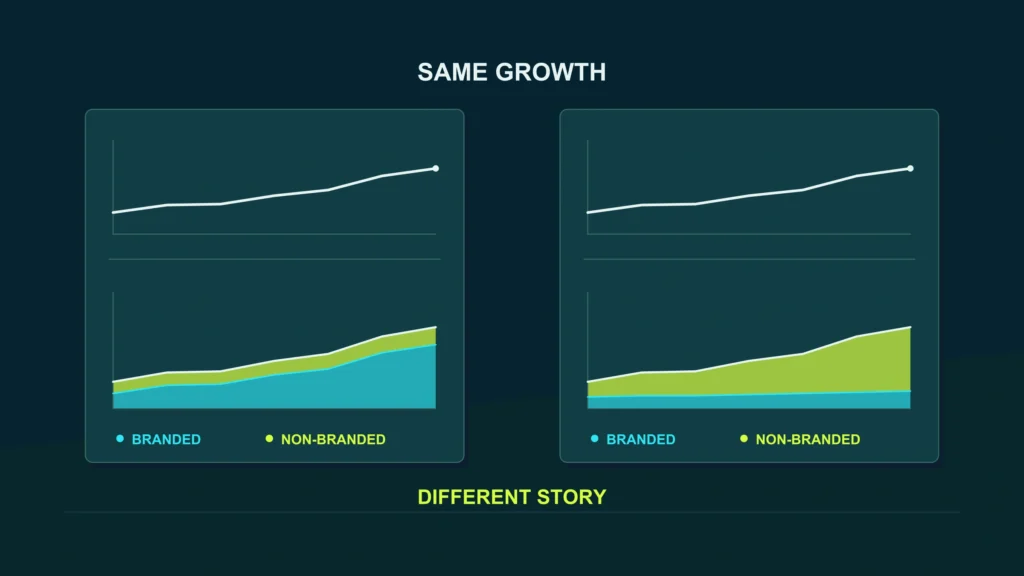
Scenario A
Of the 10,000 clicks:
- 8,900 are branded;
- 1,100 are non-branded.
The company is receiving a lot of branded search demand.
That can come from a combination of factors:
- campaigns;
- brand awareness;
- recommendations;
- public relations;
- offline advertising;
- returning customers;
- social media;
- email;
- other channels.
SEO helps capture that demand when the user reaches Google.
But we should not automatically conclude:
“Our SEO strategy is getting thousands of new people to discover the business.”
We do not know that yet.
Scenario B
Branded clicks remain relatively stable and growth is concentrated in searches such as:
erp software for small businesses;pest control mexico city;roof replacement new jersey;private tours rome.
The story is different.
Now we are seeing signs that the site is appearing to users who did not necessarily start by searching for a specific brand.
Same rising chart. Two completely different explanations.
That is the real value of segmentation.
Branded traffic is not “bad”
It is worth clarifying because this conversation often swings to the opposite extreme.
A brand that receives a lot of searches for its name may be doing many things right.
In fact, Google also includes this analysis in Search Console as a way to understand brand awareness. Search Console Insights shows the split between branded and non-branded clicks precisely to help explain where search traffic comes from.
If more and more people search directly for:
Cubo SEO
Nike running
Salesforce CRM
or any product directly associated with a company, there is specific demand around that entity.
That has value.
What we should avoid is presenting an increase in branded traffic as automatic proof that a content strategy, keyword research, or non-branded SEO strategy is working.
Metrics need context.
How to see branded vs. non-branded in Search Console
For eligible sites, Google lets you apply this segmentation directly in the performance report.
The path is simple:
Performance → Search results → Query filter → Branded / Non-branded
Then we can study separately:
- clicks;
- impressions;
- CTR;
- average position.
The filter works for different search types such as web, images, video, and news. Google also notes that it is not available for partial properties —for example, certain subdirectory properties— or for sites with insufficient impression volume.
The interesting part begins after you turn the filter on.
Simply knowing that we have “67% non-branded” still does not tell us what to do.
The five questions I would ask after separating the traffic
1. Is non-branded growing?
I would compare equivalent periods.
For example:
last three months vs. previous three months
or:
year over year, when seasonality matters.
The question is not only:
Do we have more clicks?
It is also:
Do we have more impressions?
Growth in impressions can indicate that new pages, queries, or clusters are starting to gain visibility even if they are not yet producing many clicks.
Search Console defines impressions, clicks, CTR, and average position as different metrics for a reason; none of them tells the whole story on its own.
2. Which queries are driving that growth?
“Non-branded” is still far too broad a category.
It can contain highly valuable commercial traffic and traffic that is almost irrelevant.
Growing because of:
seo consultant for businesses
is not the same as growing because of an informational question that is completely removed from the service.
That is why I would break it down into clusters:
Services
Problems
Comparison
Information
Locations
Product
And then I would ask:
Which part of demand are we actually growing in?
A good dashboard should let us move from:
NON-BRANDED +22%
to:
which topics explain that +22%?
3. Which pages are winning?
After the queries, I would review the pages.
Maybe we have:
- 30 articles growing;
- no commercial pages improving.
That can be perfectly valid if we are building topical coverage.
But it can also mean informational content is progressing while the pages closest to the business remain weak.
Or the reverse.
Perhaps a new service architecture is beginning to capture commercial queries.
The right interpretation depends on the objective.
In Search Console it is also important to remember that data can be aggregated differently by property and by URL. That especially affects metrics such as CTR and average position, so it is worth comparing equivalent views before drawing conclusions.
4. Do we have impressions but few clicks?
Here another useful analysis appears.
Suppose a page is growing in non-branded:
Impressions: +80%
but:
Clicks: +6%
The first problem may no longer be “getting more visibility.”
Perhaps we need to understand why users see the result and do not choose it.
Google specifically recommends reviewing pages with low CTR and checking whether the title, description, or content accurately reflects what the person expected to find.
But we should not fall into:
“Low CTR = change the title.”
There can be many reasons:
- position;
- query type;
- intent;
- device;
- SERP features;
- competing brand;
- a direct answer from Google;
- a page that simply does not match the search.
Diagnose first. Change things afterward.
5. Does that traffic do anything useful?
This is the question too many SEO reports leave until the end.
Or never ask at all.
We can increase:
- impressions;
- clicks;
- keywords;
- ranking pages;
and still not know whether we are generating anything meaningful for the business.
When measurement is set up properly, I would try to connect SEO clusters with actions such as:
- forms;
- calls;
- WhatsApp;
- demo requests;
- sign-ups;
- bookings;
- purchases;
- other useful conversions.
Not to force perfect attribution.
SEO rarely exists in isolation from the rest of the journey.
But to move from:
“We have 4,000 non-branded clicks.”
to something more useful:
“These are the queries and pages through which we are getting new people to discover priority services.”
That is information you can actually use to make decisions.
Four scenarios that tell different stories
I find this matrix a simple way to read the situation.
| Branded | Non-branded | Possible interpretation |
|---|---|---|
| ↑ | ↑ | Brand demand and organic discovery are both growing |
| ↑ | → | Brand demand is growing, but generic acquisition is stagnant |
| → | ↑ | SEO is expanding visibility beyond the brand |
| ↓ | ↓ | We need to investigate demand, rankings, brand, competition, and technical changes |
I would not use this table as an automatic diagnosis.
It is a starting point for investigation.
For example, a drop in branded traffic may be related to reduced campaign activity or other factors completely outside SEO.
An increase in non-branded traffic may come from a viral informational piece that has little to do with the business.
The data raises questions. It does not answer all of them.
A common mistake: calling any organic growth “SEO growth”
This is the part of the analysis that interests me most.
Imagine this presentation:
“Organic traffic grew 35% this quarter.”
Fine.
Now I want to know:
- branded or non-branded?;
- which queries?;
- which pages?;
- which country?;
- which device?;
- which intent?;
- what changed?;
- which commercial actions occurred?;
- what portion can we reasonably connect to our work?
Not because every report needs 40 slides.
Quite the opposite.
A good report could be fairly short if it answers those questions.
At Cubo SEO, I prefer to think about reporting as:
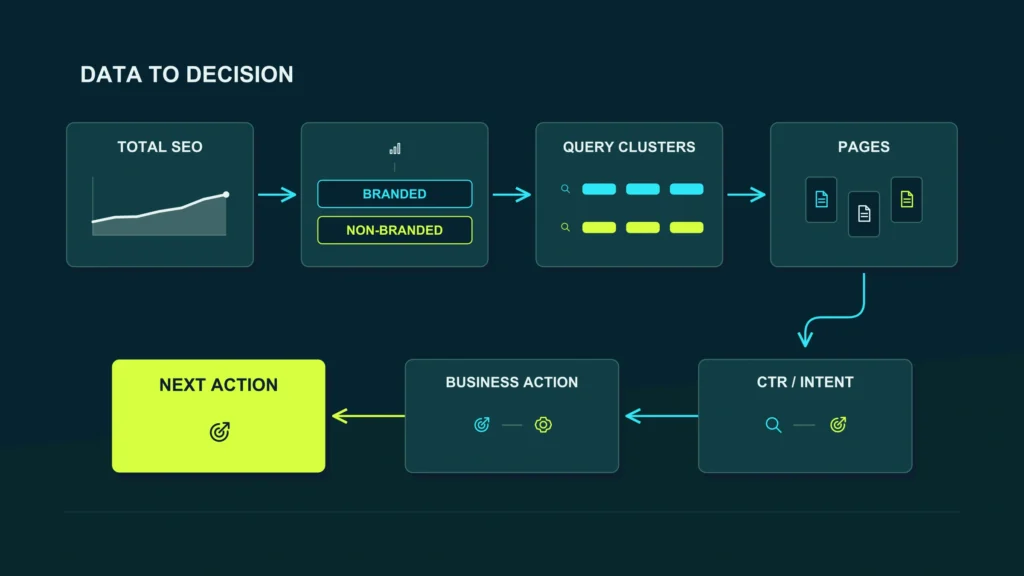
data → context → interpretation → decision
and not as:
data → chart → next chart → next chart.
What I would do if non-branded traffic is not growing
I would not automatically start by commissioning twenty articles.
First I would try to find the bottleneck.
Do we have enough commercial coverage?
We may be missing a page for a service, location, industry, or problem with demand.
Is the architecture right?
Perhaps four pages are competing for the same intent.
Do we have visibility, but rank too far down?
If many queries have impressions in low positions, we may need to strengthen content, authority, internal links, or technical factors.
Is the content offering too generic?
Publishing information any competitor can produce in five minutes is unlikely to build an advantage.
Do we have enough authority?
In competitive markets, a page can be good and still need more external signals.
Are we targeting searches that actually matter?
Keyword research can uncover thousands of terms. That does not mean all of them deserve resources.
That is where the SEO strategy should reconnect with the business.
Branded vs. non-branded should not become an obsession either
There is an interesting risk here.
We discover a new segmentation and start optimizing the dashboard instead of the business.
I do not want branded traffic to go to zero.
I do not want non-branded traffic at any cost either.
I want to understand:
what demand exists, who generates it, which pages capture it, and what value it creates.
Google’s classification is not perfect either.
Google explicitly says the system is contextual and AI-assisted, and that some queries may be classified incorrectly.
There is another practical limitation: Search Console does not show every query for privacy reasons, so any query analysis has to accept a certain level of incomplete information.
It makes no sense to demand more precision from the data than the source itself provides.
The dashboard I would actually want to look at every month
It would not need 50 KPIs.
I would start with five blocks.
1. Total performance
Clicks
Impressions
CTR
Average position
2. Branded vs. non-branded
Not just the percentage.
Also the change versus the previous period.
3. Non-branded clusters
Services
Problems
Content
Locations
Products
4. Pages
Winners
Stable
Declining
New
5. Decisions
What did we learn?
What should we change?
What should we stop doing?
What deserves more resources?
That turns Search Console into a management tool, not just a place to look at charts.
An important note in 2026: Search Console is also doing a better job of separating new surfaces
The broader direction of Search Console is to provide more context about how a site is discovered, rather than only showing an aggregated total.
In addition to the branded/non-branded filter, Google launched dedicated views in 2026 for visibility in generative features such as AI Overviews and AI Mode.
That makes it even less useful to look only at:
“Total organic clicks.”
Search is fragmenting.
Brand, non-brand, images, video, Discover, traditional results, and generative experiences can tell different stories.
Our analysis needs to evolve too.
So, is your SEO growing?
Maybe.
But it would not be enough for me to see the blue line sitting higher than it did three months ago.
I would want to know why.
If brand demand is growing, I want to understand it.
If we are gaining more non-branded discovery, I want to know which clusters are driving it.
If impressions rise but clicks do not, I want to investigate intent and the SERP.
If users arrive but do nothing, I want to look at the page and the journey.
And if a metric rises without us being able to explain what changed, I would not automatically turn it into a success story.
The goal of SEO reporting should not be to prove that “we did SEO.”
It should help us decide what to do next.
If you have organic growth but it is not clear how much comes from brand demand, how much from new demand, and which pages are driving that change, that is a good place to start an SEO assessment.
Frequently asked questions
What is branded traffic?
It is traffic from queries directly associated with a brand, including its name, variations, misspellings, and certain products or services strongly linked to it. Search Console currently uses an AI-assisted system to classify these queries.
What is non-branded traffic?
It is traffic from queries that Google classifies as not associated with the brand. It is especially useful for analyzing how a site is being discovered by people who did not begin by searching directly for that company.
Does non-branded traffic represent new users?
Not necessarily. It can be a signal of growth into new audiences, but someone who already knows the company can also perform a generic search. It should not be used as an exact substitute for a new-user metric.
Where can I find the branded and non-branded filter?
In Search Console’s Search results performance report, inside the query filter, provided the property is eligible for the feature.
Why does the filter not appear in my Search Console?
Google says it may not be available for sites with low impression volume and for certain subproperties, such as properties limited to a specific path.
Does Google classify queries perfectly?
No. Google warns that the system may incorrectly classify some branded or non-branded queries. The filter is an analysis tool, not an absolute classification.