

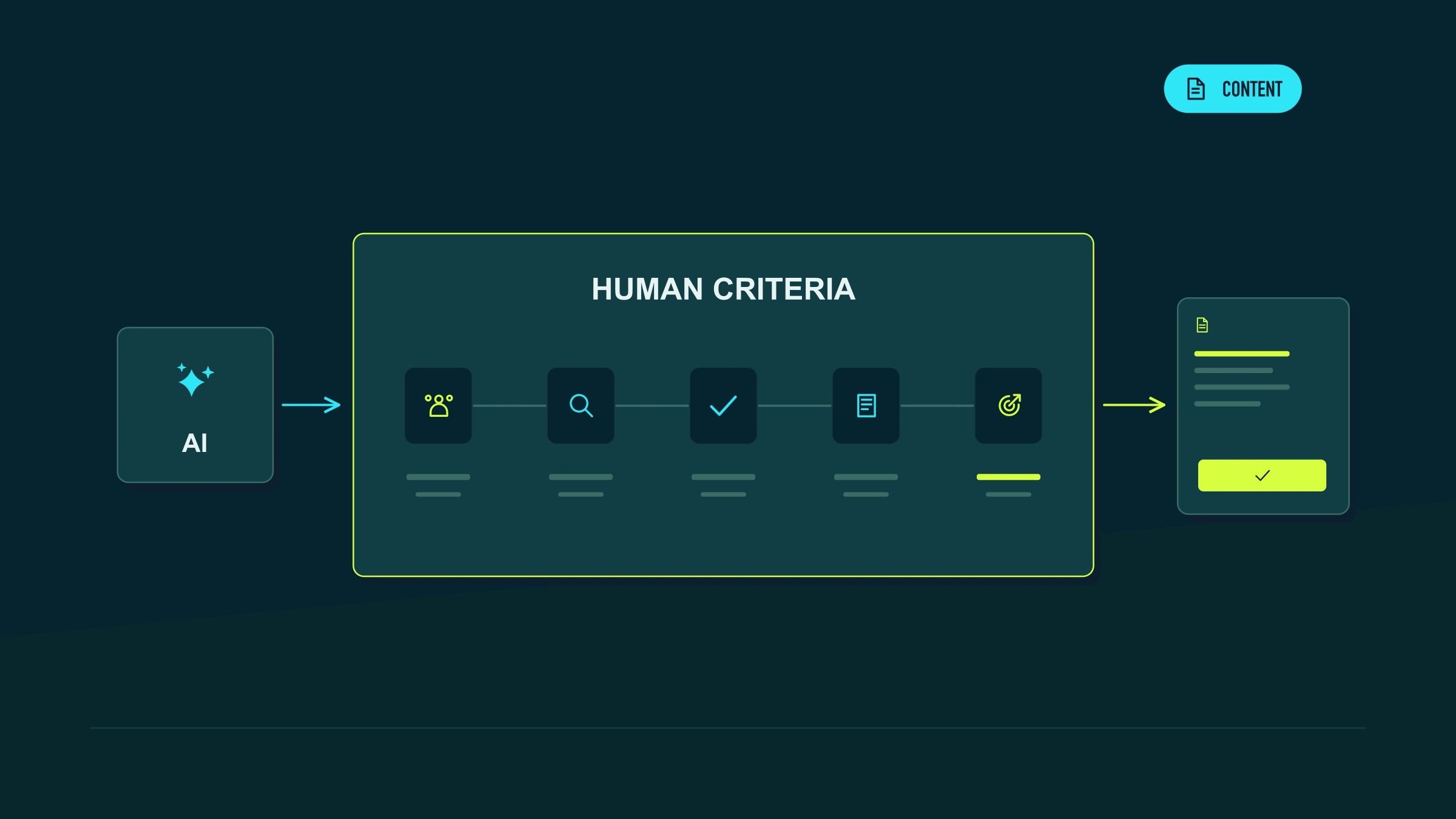
“Can I publish content created with artificial intelligence without hurting my SEO?”
That is a much more useful question than debating whether an article was written by a person, by AI, or by both.
Google does not frame the issue that way.
The main question is still something else: does the content provide something useful, original, and reliable, or are we simply using a tool to produce pages at scale that could exist on any other site?
Artificial intelligence can speed up research, organization, documentation, and writing. That does not automatically make content good or bad.
The problem starts when we confuse producing faster with having a content strategy.
And in 2026, that difference matters even more.
So, does Google penalize AI-generated content?
Not simply because artificial intelligence was used.
Google acknowledges that generative AI can be useful for researching topics and helping structure content. At the same time, it warns that using these tools to generate many pages without adding value can fall under its scaled content abuse policy.
The tool is not the main criterion.
The outcome is.
A specialist can use AI to organize research, compare information, or prepare a first draft and still end up publishing an excellent piece.
They can also manually write 1,500 words that add absolutely nothing.
That is why reducing the conversation to “human vs. AI” distracts us from the question a business should actually care about:
Does this content deserve to exist?
Google is becoming clearer about the type of content it wants
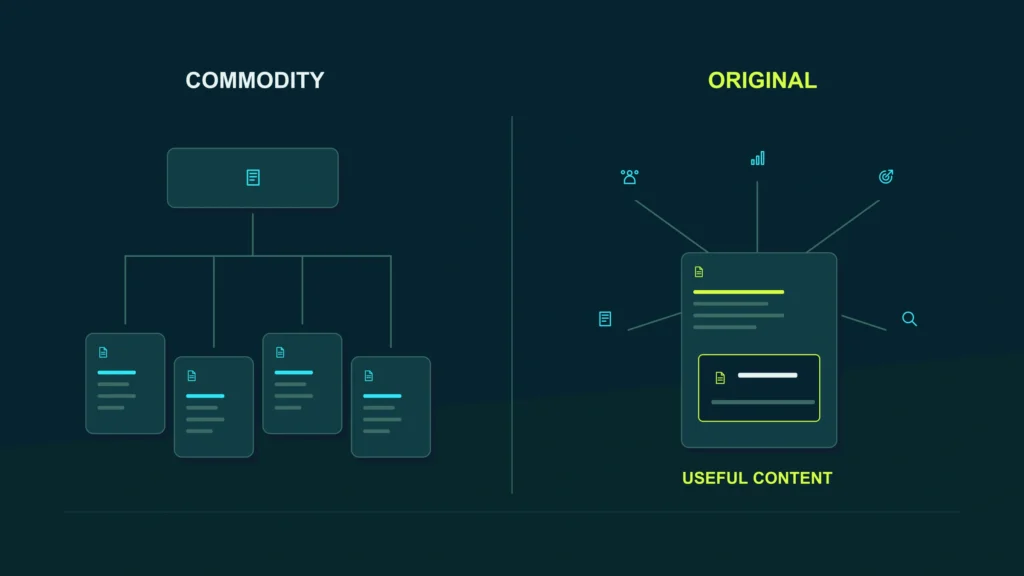
Google’s 2026 guidance for its generative AI search experiences introduces a particularly interesting expression: non-generic, or “non-commodity,” content.
Google recommends developing unique, useful content based on real knowledge instead of simply summarizing information that already exists or that a generative model could easily produce. It also discourages creating separate pages for every possible variation of a query solely to expand SEO coverage.
This affects traditional SEO as well as AI Overviews and AI Mode.
The logic is simple.
If twenty pages give practically the same answer, why should the twenty-first stand out?
What commodity content is
Imagine articles like these:
“10 benefits of SEO for businesses”
“What is digital marketing?”
“5 advantages of having a website”
“7 reasons to use artificial intelligence”
That does not mean those topics are off limits.
The problem appears when the content does little more than reorganize general knowledge.
AI can generate hundreds of similar versions in minutes.
So can your competitors.
There is very little editorial advantage in that.
Now compare that with:
“We analyzed why 90% of a company’s organic growth came from branded searches.”
“What we learned after rebuilding the service architecture of a B2B company.”
“How we decided which pages to keep after a migration.”
“What happened when a landing page had traffic but the form was breaking the customer journey.”
Now something different starts to appear.
There is context.
There is judgment.
There is a decision.
There is experience.
That is the kind of raw material that is much harder to turn into a commodity.
AI works best as part of the process
At Cubo SEO, I do not see AI as a replacement for the specialist.
I see it as a layer that can speed up certain parts of the work.
For example:
researching a market;
organizing large amounts of information;
comparing documents;
clustering queries;
preparing structures;
detecting patterns;
creating first versions;
summarizing interviews;
documenting processes;
generating alternatives that will later be reviewed.
Google also explicitly recognizes the use of AI for research and structuring, as long as the final result complies with its policies and quality standards.
What I would not do is turn the process into:
keyword → prompt → article → publish.
That removes precisely the part where a business can add the most value: judgment.
Five questions before publishing AI-assisted content
1. Are we saying something everyone else has already said?
If the piece could be swapped with the first ten Google results and nobody would notice the difference, it probably needs more work.
We do not always need to discover something revolutionary.
But we can provide a better explanation, first-hand experience, examples, data, a useful comparison, or a point of view.
2. Is there real knowledge behind it?
A business has an advantage many content generators do not have: it knows things.
It knows the questions its customers ask.
It knows why certain proposals are lost.
It knows common mistakes.
It has projects.
It has processes.
It has data.
It has sales conversations.
A good content strategy turns that internal knowledge into useful public information.
AI can help us structure it. It should not invent it.
3. Who are we writing for?
“We want traffic” is still not an audience.
A CFO evaluating an ERP does not need the same content as someone who has just discovered what ERP means.
Someone searching for “pest control prices” is closer to a decision than someone asking what cockroaches eat.
Intent still matters.
That is why a good SEO content strategy starts long before writing.
4. Can we verify what we are publishing?
This becomes especially important when we use generative models.
Dates.
Statistics.
Laws.
Product features.
Company statements.
Technical data.
Anything that can change or be wrong deserves verification.
AI can help us find a lead.
It does not turn a lead into a source.
5. Do we know what we want to happen next?
An article does not need to try to sell something in every paragraph.
But it should exist within a system.
Maybe we want the user to:
understand a problem;
discover a service;
compare alternatives;
visit a case study;
subscribe;
request information;
or simply remember the company as a trustworthy source.
If we do not know why the content exists, we probably will not know how to measure it either.
The process I would use for AI-assisted content
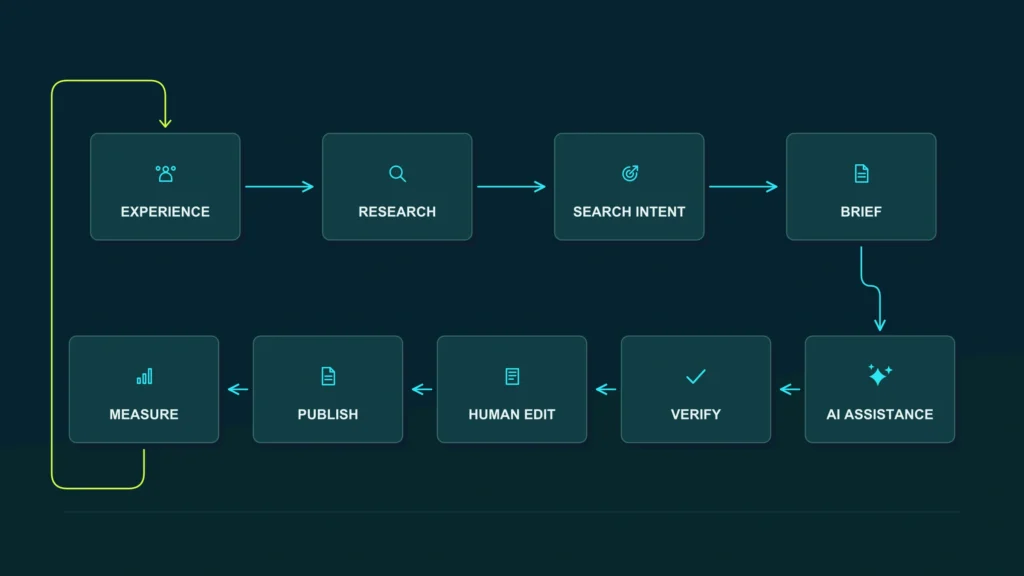
We do not need to make the process more complicated just because we are using a new tool.
I would organize it like this:
Experience and internal knowledge
→ research
→ search intent
→ brief
→ structure
→ AI support when it adds speed
→ writing
→ verification
→ human editing
→ publishing
→ measurement
→ updating.
AI fits into the system.
It does not become the system.
That distinction changes the final quality dramatically.
What I would not do in 2026
I would not publish one hundred articles simply because they now cost less to produce.
I would not create a URL for every tiny keyword variation.
I would not invent personal experiences to “add E-E-A-T.”
I would not use fictitious authors.
I would not publish statistics without knowing where they came from.
I would not systematically rewrite the results that already appear in Google.
I would not try to cover an entire industry without asking how each piece of content relates to the business.
And I would not remove AI from the process simply to be able to say everything is “100% human-written.”
That is not a strategy either.
Google specifically warns that having a large number of pages does not automatically make a site better or more relevant, and that generating content at scale without added value can fall under its spam policies.
Less content can make a stronger website
This is probably the shift that interests me most.
For a long time, editorial strategy was too easily reduced to:
more keywords → more articles → more URLs → more traffic.
It does not always work that way.
A company can have 500 articles and almost no pages that help someone make a decision.
Another can have 50 exceptionally well-connected pieces around:
services;
problems;
case studies;
comparisons;
sales questions;
real expertise.
I would rather work with the second.
Especially now that producing generic text is practically free.
The scarcity is no longer in the words.
It is in experience, data, good questions, and editorial judgment.
How do we know whether our content strategy is working?
I would not measure only how many articles we publish.
I would look at things like:
which queries start appearing;
which pages gain visibility;
which content attracts non-branded traffic;
which pieces earn links or mentions;
which pages help users discover services;
which content contributes to conversions;
which topics are not working;
what we need to update.
Reporting should help us decide whether to produce, update, consolidate, or even remove content.
Publishing is not the end of the process.
Frequently asked questions
Can Google detect whether text was created with AI?
The important question is not whether Google uses some supposed universal detector for AI-generated text. Its public guidelines focus on quality, usefulness, and compliance with its policies, not on automatically penalizing a page because a generative tool was used.
Can I use ChatGPT to write SEO articles?
Yes, as a tool within a process. Research, structure, first drafts, and organization can all benefit from AI. The final result still needs review, verification, judgment, and added value.
Can publishing a lot of AI content hurt SEO?
It can become a problem if it is used to produce content at scale with no value for users or with the primary purpose of manipulating rankings. Google addresses this under its policies on scaled content abuse.
Will an article written entirely by a person rank better?
Not necessarily. Manual authorship does not guarantee usefulness, originality, authority, or relevance.
What should a business contribute that AI cannot invent?
Experience, real case studies, proprietary data, processes, well-founded opinions, industry knowledge, examples, photographs, research, and decisions made in real situations.
The problem is not using AI. It is having nothing to contribute.
Artificial intelligence is making information production much cheaper.
That changes the competitive advantage.
Being able to publish is no longer enough.
A business needs reasons to be heard.
Experience.
Knowledge.
Data.
A point of view.
A strong editorial strategy.
And a process that turns all of that into content that helps someone.
AI can speed up that process.
But first there has to be something valuable to speed up.
If your company publishes content but it is not clear what demand it is trying to capture, what role each page plays, or what is worth producing, you can learn how we approach SEO and content strategy at Cubo SEO or request a strategic assessment.